How Self-Powered is calculated
Self-Powered is the share of your home's consumption that came from your own equipment — solar and Powerwall — instead of the grid.
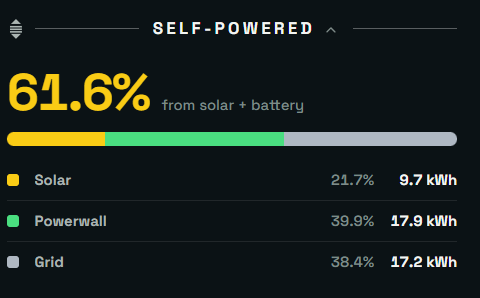
The section this page explains — on the dashboard, under your time filter.
The three sources
Every kWh your home uses is attributed to exactly one of three sources, hour by hour, from your system's own meter data:
- Solar — production that ran the house at the moment it was generated, after any solar that was filling a charging battery (see below).
- Powerwall — energy the battery discharged into the house. This is where your stored solar shows up: it went in as solar earlier, it comes out as Powerwall now.
- Grid — everything else.
Grid energy that charged your battery or your car is not home consumption and is never counted against you.
Matched to the Tesla app
When solar is generating at the same moment the battery is charging, someone has to decide which one the solar "went to." SolDial uses the same convention as the Tesla app: solar fills the charging battery first, then serves the house, then the car, then exports. That matches the flow animation you watch in both apps, and it means the two apps tell one story: heavy charging days show the grid carrying the house while your solar banks into the battery for later.
Two physical rules keep the split honest. The battery is never credited with more than it actually discharged — on a heavy charging day (storm prep, a Tesla calibration cycle) the house genuinely runs on grid, and the numbers say so. And the split is computed hour by hour, never by summing a period first — summing first would credit every solar kWh as if it powered the house directly, which is impossible across a day, let alone a year.
Why the two apps can still differ slightly
Tesla computes on its own internal telemetry at finer-than-hourly resolution and applies its own loss accounting, and its exact method isn't published. With the shared convention above, SolDial typically lands within a point or two of the Tesla app's Impact number. A calibration or storm-prep day is the stress test: both apps will show your self-powered share dropping as the grid deliberately fills your battery — that's the system working, not a problem.
Before this date, SolDial attributed solar to the home first and computed the split from period totals, which could read dramatically higher than the Tesla app on battery-heavy days (one calibration day showed 88% here against Tesla's 50%). The split now uses the hour-by-hour method above with the Tesla-matched ordering and the physical discharge cap. Savings totals were not affected by the ordering change — only how credit divides between the Solar and Powerwall buckets.